
Surprising fact: a large share of DeFi losses aren’t from clever hacks of consensus but from “blind signing” — users authorizing transactions without fully understanding consequences. Rabby Wallet tackles that exact problem by simulating every transaction before you sign it. For U.S.-based DeFi power users who routinely hop among protocols and L2s, that simulation plus automatic network switching reshapes how you think about operational security and transaction hygiene.
This explainer walks through the mechanisms behind the Rabby Wallet extension, practical trade-offs when you install and use it, and decision heuristics for power users who need accurate previews, multi-chain convenience, and hardware-wallet grade custody. It synthesizes what Rabby currently offers, what it leaves to other services, and how to evaluate it against alternatives like MetaMask or institutional multi-sig flows.
How Rabby’s extension works under the hood
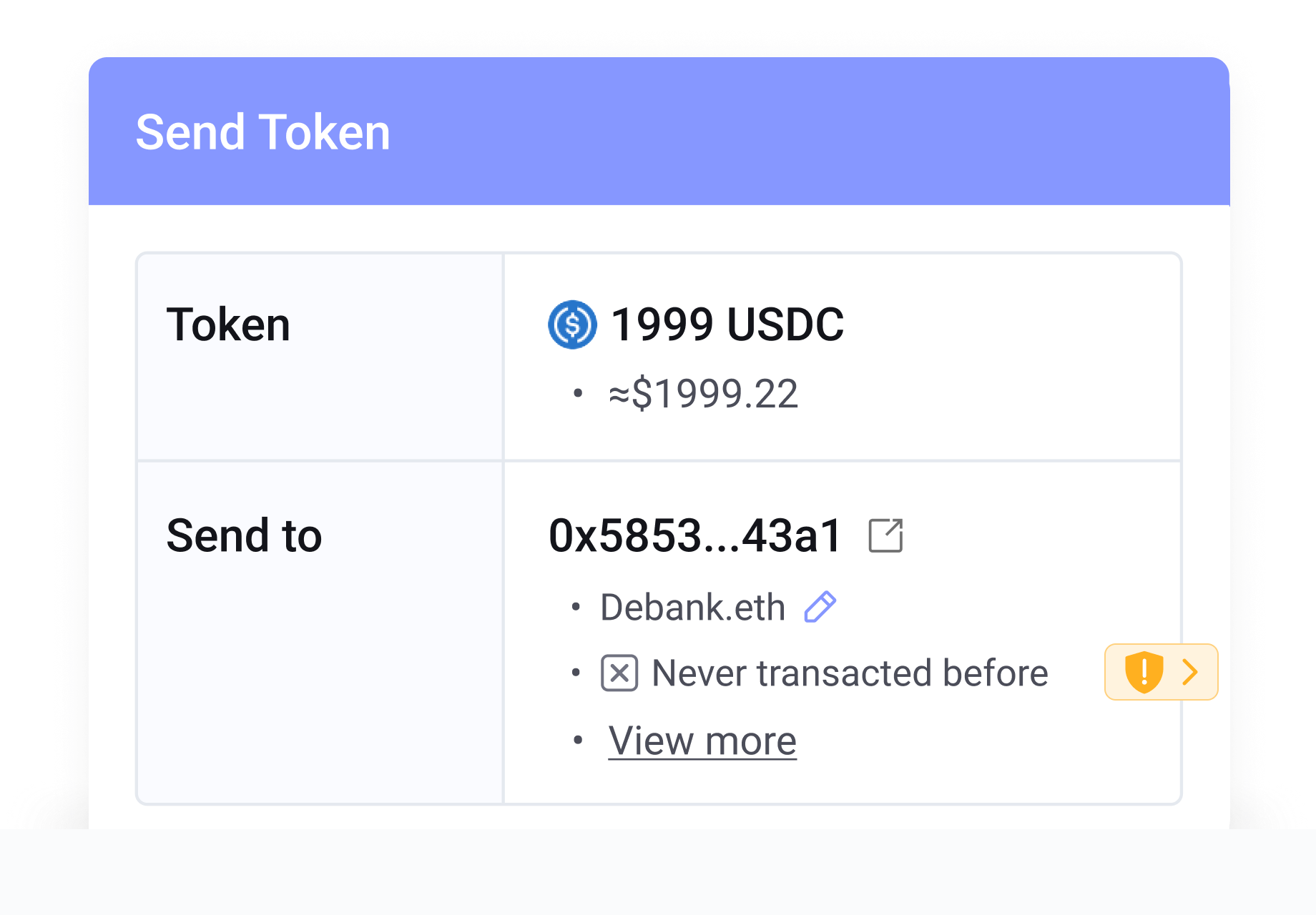
At a mechanistic level Rabby is a non-custodial browser extension that sits between your browser and dApps. When a dApp asks for a signature or to execute a transaction, Rabby intercepts the request and runs a deterministic simulation of the on-chain effects. The extension then presents estimated token balance changes, gas cost, and common risk signals (for example, interactions with contracts previously associated with exploits). This is different from mere parameter display — the simulation executes a dry-run using network data to reveal net token movement and fees before you ever sign.
Automatic network switching is another operational convenience: Rabby detects the chain that a dApp expects and prompts or switches your connected network automatically. For users who move across Ethereum mainnet, Arbitrum, Optimism, Polygon, BNB Chain and dozens of smaller EVMs, that reduces friction and prevents the expensive mistake of, say, sending a transaction on the wrong chain because your wallet was still set to Ethereum mainnet.
Rabby’s architecture is open source (MIT license), which matters technically and practically: independent auditors and the community can inspect the code path that produces the simulations and pre-transaction scanning. Because the extension supports hardware wallets (Ledger, Trezor, Keystone, and others), Rabby can act as an enriched UI layer while private keys remain offline.
Installation and practical setup notes for U.S. power users
To install the Rabby browser extension you use standard Chromium-extension flows (Chrome, Brave, Edge). After installing, import an existing wallet via seed phrase or create a fresh one. Power users should consider these immediacy steps: enable hardware wallet integration if you use a ledger device; test the transaction simulation on a small transfer to confirm how Rabby reports balance deltas; and toggle the Flip feature only if you want Rabby to replace MetaMask as your default provider in the browser.
For those who prefer a direct resource while installing, refer to the official guide at rabby wallet which consolidates download and onboarding pointers for the extension and clients.
What Rabby changes for DeFi workflows — and where it doesn’t
Rabby’s core value proposition for DeFi power users is behavioral: it reduces “blind signing” by giving a clear preview of state changes. That changes the marginal cost of checking — if previews are reliable, you are more likely to verify every permit and transfer. The built-in approval revocation tool and pre-transaction risk scanning shift portfolio hygiene from an occasional audit to an integrated part of signing flows.
But Rabby is not a complete bank replacement. It lacks a built-in fiat on-ramp, so U.S. users still need centralized on-ramps (exchanges or third-party services) to buy crypto with USD. Likewise, it does not offer native staking dashboards inside the wallet; staking management still happens through protocol UIs or third-party dashboards. Those absences reflect trade-offs: Rabby focuses tightly on secure signing, cross-chain convenience, and integration with institutional custody rather than monetizing through on-ramps or staking features.
Another trade-off concerns centralization vectors: Rabby’s automatic network switching and simulated previews rely on precise network data and contract metadata. If that metadata is stale or manipulated, your preview might miss novelty risks. The open-source codebase mitigates long-term risk, but real-time data integrity depends on infrastructure and oracle-like sources — a boundary condition to keep in mind.
Security profile: what Rabby does well and what to watch
Rabby has several strong security primitives: transaction simulation (prevents many forms of blind signing), pre-transaction risk scanning (flags suspicious approvals and known hacked contracts), hardware wallet compatibility (keeps private keys off the host), and the ability to revoke approvals. Together these reduce attack surface in routine DeFi activity.
Historically, Rabby’s ecosystem wasn’t perfect: a 2022 exploit of a related Rabby Swap smart contract resulted in losses and prompted remedial action, including freezing the contract and compensating users. That response demonstrates operational responsibility, but it also underscores a deeper truth: wallets are one layer in a broader system that includes smart contracts, relayers, and dApps. A secure wallet reduces but cannot eliminate protocol-level risk.
For institutional and multi-sig use, Rabby’s integrations with solutions like Gnosis Safe, Fireblocks, Amber, and Cobo Wallet mean it can fit into higher-trust custody and workflow stacks. That is an important option for U.S. entities that must combine operational agility with governance controls.
Decision heuristics for advanced users
When deciding whether to install and rely on Rabby, weigh these heuristics:
1) If you routinely interact with multiple EVM chains (90+ supported), the automatic network switching and cross-chain gas top-up materially reduce friction and error costs. 2) If your threat model centers on accidental approvals and blind signing, Rabby’s pre-simulation and revocation tools offer measurable mitigation. 3) If you need fiat-on ramps or integrated staking inside a wallet UI, Rabby does not provide those — plan a hybrid workflow. 4) If you run institutional flows, test Rabby with hardware wallets and multi-sig integrations before moving large balances; integration tests reveal UX edge cases that matter under operational load.
One practical framework: treat Rabby as an “execution safety layer.” Use it to harden signing decisions and approval hygiene, but pair it with separate custody/on-ramp services when you need fiat conversion, centralized compliance, or bespoke staking management.
Where Rabby might evolve and what to watch next
Recent messaging from the project emphasizes being a convenient go-to wallet for all EVM chains, which suggests continued investment in cross-chain UX and security tooling. Watch for developments in real-time contract risk feeds, additional institutional integrations, or improvements in how Rabby validates metadata used in simulations. If Rabby adds a native fiat on-ramp or staking dashboards, that would shift its position from a focused execution-safety layer to a broader consumer financial experience — but also open different regulatory and operational trade-offs.
Signals that would change my view: reliable decentralised metadata sources for contract risk, tighter hardware wallet UX in multi-sig contexts, or official support agreements with regulated on-ramps in the U.S. Conversely, increased feature bloat without maintained audit coverage could weaken the security guarantees that make Rabby attractive today.
FAQ
Q: Is the Rabby browser extension safe to install and use with a hardware wallet?
A: Yes — Rabby supports Ledger, Trezor, and other hardware devices, and is designed to operate as an enriched interface while keeping keys offline. Still, follow hardware vendor guidance (firmware updates, verified apps) and test with small transactions before scaling up.
Q: Will Rabby prevent me from losing funds if a dApp is malicious?
A: Rabby reduces risk by simulating transactions, flagging known malicious contracts, and allowing approval revocation. It does not make you invulnerable: novel exploits, deceptive UX in dApps, or off-chain social engineering can still lead to loss. Treat Rabby as a strong defensive tool, not an absolute shield.
Q: Does Rabby offer a fiat on-ramp or staking inside the wallet?
A: Currently it does not provide a built-in fiat on-ramp or native in-wallet staking. Users in the U.S. will need third-party services for buying crypto with USD and protocol UIs or dashboards for staking management.
Q: How does Rabby compare to MetaMask for power users?
A: Mechanically, both are non-custodial EVM wallets, but Rabby differentiates by defaulting to transaction simulation, automatic network switching, and integrated revocation tools. MetaMask has broader market penetration and some ecosystem plugins, but Rabby is purpose-built to reduce blind-signing risk and improve multi-chain hygiene.
Takeaway: for U.S. DeFi power users the Rabby extension represents a meaningful shift in execution safety. It is not a silver bullet, but by converting uncertain, one-click signing into an informed decision — with simulated balances, flagged risks, and easy revocations — Rabby raises the baseline level of operational security. Pair it with hardware wallets and institutional custody flows where appropriate, accept its current limits (no fiat on-ramp, no built-in staking), and treat it as a practical layer in a multi-tool DeFi toolkit.