
Counterintuitive claim: logging into an exchange is often the single most consequential trading decision you make — because the login determines custody boundaries, recovery options, and the attack surface you expose. For U.S.-based traders approaching OKX, the mechanics of account access (KYC, 2FA, biometric options), the differences between spot/margin and futures products, and the platform’s custody model together define what trades you can place, how quickly you can react, and how much operational risk you tolerate.
This piece translates how OKX’s login and account controls map to actual trading choices: when to use spot vs. margin, how futures amplify both returns and operational risk, and which practical security steps materially reduce loss from external attacks or internal mistakes. I’ll assume you’re familiar with basic crypto terms; the goal is to sharpen your decision framework so a login is not merely a convenience but a risk-management lever.
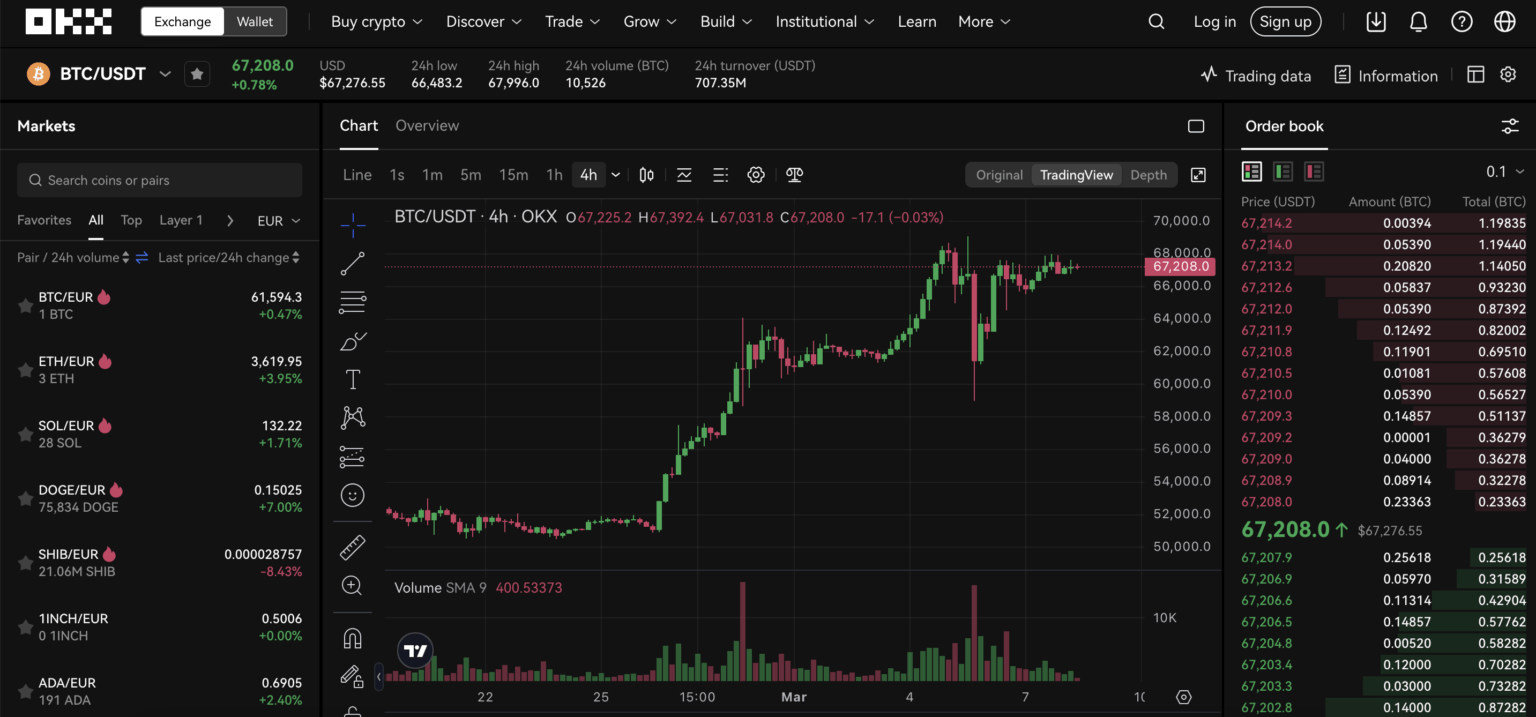
How the OKX login maps to custody and control
Mechanism first: creating and verifying an OKX account in the U.S. requires Know Your Customer (KYC) checks — a government ID and a facial liveness check — and then account protection layers like mandatory Two-Factor Authentication (2FA). These steps are not bureaucratic hurdles; they define custody boundaries. KYC ties an account to an identity, which allows fiat on-ramps, regulatory compliance, and recovery paths through the exchange. 2FA and biometric login options (on mobile) reduce credential reuse risk, but each method has different threat models: SMS 2FA can be vulnerable to SIM swap, while app-based authenticators or hardware security keys offer stronger protection but slightly more friction in recovery.
OKX also advertises AI-driven threat detection and military-grade encryption to flag suspicious logins. Those systems can block obvious attempts, but they are not omnipotent. An attacker who successfully social-engineers your email, or convinces a support agent to approve a recovery, can bypass automated defenses. This is why the login decision — which 2FA method to enable, whether to register IP whitelisting, whether to bind withdrawals to allowlist addresses — should be made explicitly as part of your asset protection plan rather than passively during setup.
Spot trading vs. margin on OKX: access, trade-offs, and failure modes
Spot trading on OKX is straightforward: buy and sell at market prices with custody held by the exchange. The practical benefits are speed of execution, access to over 300 assets, and straightforward settlement. For many U.S. traders, spot trading is the right baseline because it avoids liquidation mechanics and funding-rate complexities inherent to derivatives.
Margin trading introduces borrowed capital to amplify returns and losses — up to 10x on OKX depending on asset and margin mode (isolated or cross). The mechanisms matter: isolated margin limits the risk to a single position, while cross-margin pools collateral across positions. That choice is a trade-off between operational simplicity (cross-margin) and compartmentalized risk (isolated). Margin also increases your exposure to market microstructure problems: in low-liquidity moments or during rapid moves, slippage and wide bid-ask spreads can cause a margin call and forced liquidation before you can react.
A recent operational consideration: OKX periodically delists spot pairs (this week it removed a handful of small-cap pairs). Delistings are routine but meaningful: if you hold a delisted token in spot form, liquidity and withdrawal routes may change. For any leveraged position that includes delisted or thinly traded coins, your margin cushion should be larger to account for reduced exit liquidity.
Futures and derivatives: leverage, liquidity, and the behavioral risk
OKX provides perpetual swaps, quarterly futures, and options — with maximum leverage up to 125x on selected products. Mechanistically, higher leverage is not only a multiplier of returns; it also compresses the time window you have to respond to adverse price moves. At 125x, a fraction-of-a-percent adverse move can wipe equity. That makes operational discipline—position sizing, stop logic, and pre-placed collateral—more important than skillful entry timing.
Liquidity matters here. Perpetuals often have deep order books for majors like BTC and ETH, but quarterly or options markets for niche tokens can be thin. Thin books amplify slippage and increase the probability that liquidations cascade, moving the market further against remaining positions. For U.S. traders, a practical heuristic is to cap leverage according to realized liquidity (e.g., use much lower leverage for altcoin futures than for BTC/ETH perpetuals) and to simulate worst-case fills before committing capital.
Another parsing: futures occupy a hybrid custody logic. Although positions are on the exchange, some firms detach collateral into separate custody flows for risk management; retail users rarely have that luxury. Know that any leverage trade you place is simultaneously a bet on market direction and on the exchange’s operational continuity — funding payments, margin engine robustness, and withdrawal cadence all matter.
Login, custody, and operational hygiene: a practical checklist
Because login choices materially change failure modes, here is a prioritized checklist you can use when setting up or auditing an OKX account for active trading:
1) Use an app-based authenticator or hardware security key for 2FA where possible; reserve SMS only as a last resort. 2) Enable withdrawal address allowlists and, for large amounts, require delay periods on withdrawals. 3) Separate funds by intent: keep capital for immediate trading on the exchange and larger, long-term holdings in cold or self-custodial storage (OKX stores >95% in cold wallets). 4) If you trade futures, predefine maximum acceptable leverage and maintain an independent margin buffer to avoid forced liquidation. 5) Keep recovery means documented but secure — losing access to a KYC-tied account is not frictionless, and social-recovery attempts can be slow or fail.
One trade-off here is convenience versus security. Biometric mobile login is fast and reduces password fatigue, but it centralizes an authentication factor in a device that, if compromised, can provide direct access. App-based authenticators and hardware keys add friction but reduce the probability of a catastrophic breach. Decide based on the scale of assets and your operational tolerance for convenience losses.
Where OKX’s architecture strengthens or limits trader defenses
On the strength side, OKX offers several industry-grade protections: a high proportion of assets in air-gapped cold storage, Proof of Reserves transparency, and a non-custodial Web3 wallet option for users who prefer self-custody. These mechanisms reduce certain systemic risks — cold storage reduces hot-wallet theft risk; PoR helps reassure about solvency claims.
But limits remain. Proof of Reserves attests to backing at a point in time and does not prevent future operational failures or smart-contract exploits in DeFi features. The Web3 wallet gives full private key control, which is safer from exchange-centric hacks but introduces single-user responsibility risks: lose the seed phrase and assets are irrecoverable. That dichotomy—centralized protections versus self-custody responsibility—underpins a key decision framework for traders.
Decision-useful heuristics: a mental model for choosing mode and access
Here are three heuristics to operationalize the trade-offs you now understand:
– Purpose-first custody: classify assets by timeframe and purpose (spot for short-term trades, cold/self-custody for long-term holds, exchange margin for tactical allocations only).
– Liquidity-aware leverage: match leverage to market depth; never apply the same leverage across assets with different liquidity profiles.
– Attack-surface minimization: treat every login method, device, and browser extension as a potential vector; use compartmentalization (separate devices/accounts) for high-risk operations like margin adjustments or withdrawal whitelisting.
What to watch next (signals that change the calculus)
Monitor regulatory developments affecting U.S. access to derivatives, delisting notices for low-volume tokens, and any amendments to OKX’s KYC or withdrawal policies. Operational indicators to watch on the platform itself include funding-rate volatility (a signal of stress in perpetual markets), sudden spreads widening on spot pairs (liquidity drying up), and changes in PoR disclosures. The platform’s recent delistings of several small-cap spot pairs remind traders that token availability and liquidity are dynamic considerations for both spot and margin strategies.
If you want a direct start point for OKX web access and the login pathways discussed here, the exchange’s login guide is available at this link: okx.
FAQ
Q: Is it safer to keep all funds on OKX for convenience?
A: Not necessarily. Convenience reduces friction to trade but increases custodial risk. A balanced approach is to keep an operational trading float on the exchange and move larger holdings to cold storage or a self-custodial Web3 wallet that you control. This partitioning reduces the impact of exchange-level incidents while preserving trading agility.
Q: Which 2FA method should U.S. traders use for the best risk trade-off?
A: An app-based authenticator (Google Authenticator, Authy with encrypted backups, or a hardware security key like a U2F device) offers the best combination of security vs. recoverability for most traders. SMS 2FA is convenient but vulnerable to SIM swaps; biometrics are fast but device-tied. Choose based on asset size and your personal recovery plan.
Q: How much margin buffer should I keep when trading OKX futures?
A: There’s no universal number; a practical rule is to size margin so that a move equal to the product of your worst-case slippage and expected volatility does not trigger liquidation. For major perpetuals with deep liquidity, smaller buffers suffice; for altcoin futures, increase buffers and reduce leverage. Simulate fills or paper-trade to refine your buffer assumptions.
Q: Can withdrawing to a self-custodial wallet fully eliminate risk?
A: It eliminates custodial counterparty risk but introduces user-responsibility risks: if you lose your seed phrase or fall victim to a phishing contract, recovery is unlikely. Use hardware wallets for large balances and verify contract interactions carefully when using DeFi features.